
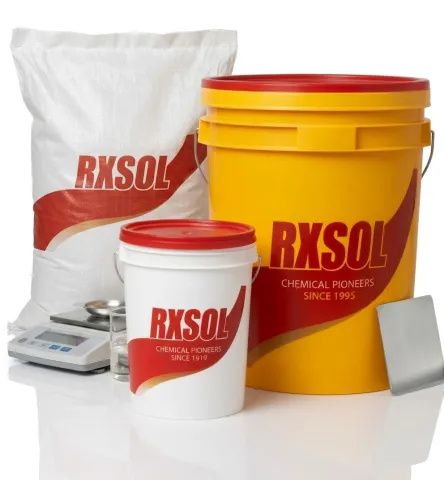
Heat Transfer Salt
Part No. RXSOL-42-1436-025
Salt inhibited with the corrosion inhibitor resulting corrosion protection, as well as efficient heat transfer. Heat Transfer Salt with the increased use of high-temperature operations, the chemical and petroleum process industries need an economical
Salt inhibited with the corrosion inhibitor resulting corrosion protection, as well as efficient heat transfer. Heat Transfer Salt with the increased use of high-temperature operations, the chemical and petroleum process industries need an economical, efficient, heat transfer medium
| Main Ingredients | : | Salt Mixture with Corrosion Inhibitor |
|
Inhibitors and
water
6
Inhibitors
|
: | 6 % |
| Colour Bright | : | Yellow |
| Nitrite Content | : | 7.5 to 8.5% |
| Chloride Content | : | 0.10% Max. |
| pH of solution | : | 9.5 - 10.5 |
| Odour | : | PRACTICALLY ODOURLESS |
| Solubility in water | : | SOLUBLE |
| Melting Point | : | Max 150 - 155 °C |
| Working Temp Range | : | 155 – 540 Deg.C |
| Density @ 20 Deg.C | : | 1160 Kg/m3 |
| Reverse Alkalinity | : | Minimm 15.0 ml |
| Vapour pressure | : | .07 mbar at 20oC |
| Hear Transfer Salt TR | : | 155 |
| Skin absorption/irritation | : | YES |
| TLV Country | : | |
| Pollution category 1994 | : |
III |
Heat Transfer Salt kept in between steam and direct-fire heating. Heat Transfer salt has low melting point to create a molten salt bath also have high heat transfer rate and its proprietory blend of heat transfer salt is stable at high temperatures, and is non-corrosive to steel. The salts are used for indirect heating and cooling or as quenching baths in the annealing of iron and steel.
Dosage
Heat Transfer Salt with the increased use of high-temperature operations, the chemical and petroleum process industries need an economical, efficient, heat transfer medium that is between steam and direct-fire heating. Sodium nitrite can be mixed with nitrate salts to create a molten salt bath. It has a low melting point, high heat transfer rate, is stable at high temperatures, and is non-corrosive to steel. The salts are used for indirect heating and cooling or as quenching baths in the annealing of iron and steel.
Useful Area
Heat Transfer Salt Molten salts are also used in applications of solar power plants (CSP), where the salt can store heat obtained from sunlight for long periods of time. Some of these CSP systems flow the salt directly through the receiver tubing, where sunlight hits a parabolic mirror and concentrates the sunlight to a tube in which the salt flows.
Other systems may use molten salts for preheating natural gas lines or keeping reactors hot by using the molten salt in the jacket around a tank. Salts also have relatively high latent heat capacity — similar to many of the phase-change waxes that are used today — and are sometimes used in phase-change applications. When salts melt, they absorb large amounts of heat, and when they freeze, they release large amounts of heat. By utilizing this phenomenon, it is possible to create advanced thermal storage or temperature-regulating systems, depending on the process.
Remarks
Why use Heat Transfer molten salts?
Heat Transfer Salt extend the upper range of the temperature limits in which a liquid heat transfer media can be used.
Supply Locations
Heat Transfer Salt manufacturer and supplier in Mumbai, Kandla, Chennai, Kolkata, Visakhapatnam, Barka - Oman, Muscat, Fujairah, Dubai, Sharjah, Abudhabi, Ajman, Oman Muscat Barka, Canada, Nairobi Kenya, Uganda Africa, Bahrain